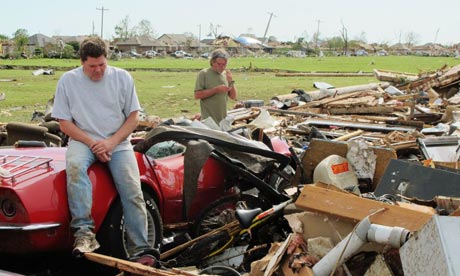
Moore, Oklahoma. Experts believe the cost of damage from the devastating tornado could exceed £3bn. Photograph: Sean Murphy/AP
Rescue workers were preparing on Wednesday to wind up a search for victims and survivors in the Oklahoma city of Moore after it was slammed by a deadly tornado.
Though the twister levelled entire city blocks, flattened two schools and killed 24 people while injuring more than 240 it was becoming clear amid the rubble that the disaster could have been far worse.
Initial fears that perhaps around 90 people might have been killed by the ferocious storm were retracted by local officials and now authorities on Wednesday said that no one remained on the missing list.
That meant that the teams of rescue workers that had descended on Moore's slice of middle American suburbia, just south of Oklahoma City, were now starting a clean-up operation, rather than a search-and-recovery one.
Jerry Lojka, spokesman for Oklahoma Emergency Management, told the Reuters news agency that search-and-rescue dog teams would search for anybody trapped under the rubble, but that attention would focus on clearing the rubble and debris now littering a huge part of the town. "They will continue the searches of areas to be sure nothing is overlooked," he said. "There's going to be more of a transition to recovery."
Officials said they were no longer knowingly looking for any more bodies, having pulled more than 100 people alive from the ruins left by twister's path. Oklahoma County commissioner Brian Maughan told reporters, after a tour of the devastated community, that it now seemed no one was still listed as missing. "As far as I know, of the list of people that we have had that they are all accounted for in one way or another," he said.
But the clean-up – let alone the recovery – will be an enormous job. The tornado left a trail of destruction 17 miles long from the spot where it touched down outside of Oklahoma City and then along the path that it tracked as it headed into Moore. At its height it was 1.3 miles wide and packed winds that raged at more than 200mph. The National Weather Service declared it a rare EF-5 tornado – the top level of the Enhanced Fujita Scale used to measure their power and destructive potential.
The tornado was the worst to hit the United States since a storm ploughed Joplin, Missouri, exactly two years ago and killed 158 people. The Moore storm, though far less lethal, has nonetheless left 2,400 homes damaged or destroyed and affected an estimated 10,000 people. Insurance experts believe the eventual cost of the storm will actually exceed the Joplin disaster, which ended up causing $3bn of damage.
But, despite that, Moore clearly had a relatively lucky escape. Experts explained the relatively low death toll in Moore to an effective early warning system and a prevalence of storm shelters in homes in the area, many of which had been built after a similar storm struck Moore in 1999. "There would have been a lot more people killed, we believe, if they had not had that warning 14 years ago," Oklahoma senator James Inhofe told CNN.
Already the Oklahoma state legislature is drafting a law to allow the local government to tap into the states "rainy day" fund for $45bn in cash to help finance the rebuilding effort in the city of 55,000 people. Meanwhile President Obama has also pledged that the federal government will do everything it can to help in the rebuilding effort.
In a speech to the nation on Tuesday, Obama vowed to the people of Moore: "You will not travel that path (to recovery) alone. Your country will travel it with you, fuelled by our faith in the Almighty and our faith in one another."
But there is already a political row brewing over the extent and cost of federal aid in the wake of the disaster. Inhofe and his fellow Republican senator from Oklahoma, Tom Coburn, have a long record of opposing federal funding for disaster relief. Both politicians opposed last year's $60.4bn aid bill for victims of Hurricane Sandy and are now in a political bind as they face the prospect of reversing that opinion for Moore or having to oppose aid to their own voters.
Inhofe has been telling reporters that the situation in Moore is different from Sandy because the legislation to help storm-struck east coast last year was laden with unnecessary funding for other projects. Meanwhile, Coburn has stated that he supports aid to help Moore as long as the costs of that help are cut from elsewhere in the federal budget.really nice is'nt it?
Though the twister levelled entire city blocks, flattened two schools and killed 24 people while injuring more than 240 it was becoming clear amid the rubble that the disaster could have been far worse.
Initial fears that perhaps around 90 people might have been killed by the ferocious storm were retracted by local officials and now authorities on Wednesday said that no one remained on the missing list.
That meant that the teams of rescue workers that had descended on Moore's slice of middle American suburbia, just south of Oklahoma City, were now starting a clean-up operation, rather than a search-and-recovery one.
Jerry Lojka, spokesman for Oklahoma Emergency Management, told the Reuters news agency that search-and-rescue dog teams would search for anybody trapped under the rubble, but that attention would focus on clearing the rubble and debris now littering a huge part of the town. "They will continue the searches of areas to be sure nothing is overlooked," he said. "There's going to be more of a transition to recovery."
Officials said they were no longer knowingly looking for any more bodies, having pulled more than 100 people alive from the ruins left by twister's path. Oklahoma County commissioner Brian Maughan told reporters, after a tour of the devastated community, that it now seemed no one was still listed as missing. "As far as I know, of the list of people that we have had that they are all accounted for in one way or another," he said.
But the clean-up – let alone the recovery – will be an enormous job. The tornado left a trail of destruction 17 miles long from the spot where it touched down outside of Oklahoma City and then along the path that it tracked as it headed into Moore. At its height it was 1.3 miles wide and packed winds that raged at more than 200mph. The National Weather Service declared it a rare EF-5 tornado – the top level of the Enhanced Fujita Scale used to measure their power and destructive potential.
The tornado was the worst to hit the United States since a storm ploughed Joplin, Missouri, exactly two years ago and killed 158 people. The Moore storm, though far less lethal, has nonetheless left 2,400 homes damaged or destroyed and affected an estimated 10,000 people. Insurance experts believe the eventual cost of the storm will actually exceed the Joplin disaster, which ended up causing $3bn of damage.
But, despite that, Moore clearly had a relatively lucky escape. Experts explained the relatively low death toll in Moore to an effective early warning system and a prevalence of storm shelters in homes in the area, many of which had been built after a similar storm struck Moore in 1999. "There would have been a lot more people killed, we believe, if they had not had that warning 14 years ago," Oklahoma senator James Inhofe told CNN.
Already the Oklahoma state legislature is drafting a law to allow the local government to tap into the states "rainy day" fund for $45bn in cash to help finance the rebuilding effort in the city of 55,000 people. Meanwhile President Obama has also pledged that the federal government will do everything it can to help in the rebuilding effort.
In a speech to the nation on Tuesday, Obama vowed to the people of Moore: "You will not travel that path (to recovery) alone. Your country will travel it with you, fuelled by our faith in the Almighty and our faith in one another."
But there is already a political row brewing over the extent and cost of federal aid in the wake of the disaster. Inhofe and his fellow Republican senator from Oklahoma, Tom Coburn, have a long record of opposing federal funding for disaster relief. Both politicians opposed last year's $60.4bn aid bill for victims of Hurricane Sandy and are now in a political bind as they face the prospect of reversing that opinion for Moore or having to oppose aid to their own voters.
Inhofe has been telling reporters that the situation in Moore is different from Sandy because the legislation to help storm-struck east coast last year was laden with unnecessary funding for other projects. Meanwhile, Coburn has stated that he supports aid to help Moore as long as the costs of that help are cut from elsewhere in the federal budget.really nice is'nt it?

No comments:
Post a Comment